

A Multidisciplinary Path to Pediatric Heart Transplantation: Evelyn’s Story
On Hannah’s 27th birthday—and Evelyn’s six-month birthday—Evelyn was in the operating room at Children’s Mercy undergoing an orthotopic heart transplant. After nearly 12 hours of surgery, her parents received confirmation of a successful transplant and were able to briefly visit their daughter that evening. For the clinical team and family alike, the moment marked the culmination of years of careful monitoring, complex decision-making and prolonged waiting.
Prenatal Diagnosis and Early Postnatal Intervention
Evelyn’s care journey began prenatally when a routine 20-week anatomy scan identified potential congenital heart disease. She was referred to the Elizabeth J. Ferrell Fetal Health Center at Children’s Mercy, where she was diagnosed with critical aortic stenosis. The diagnosis prompted close weekly fetal surveillance, as physiologic changes from fetal to postnatal circulation would ultimately determine postnatal management.
“Physiology changes so much from fetal to postnatal life that you really don’t know how things are going to look,” said Brian Birnbaum, MD, FACC, FAAP, Interim Division Chief of Cardiology. 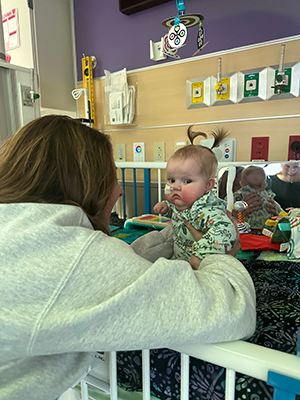
Evelyn was delivered at 39 weeks via planned C-section at the Fetal Health Center in May 2023. Immediately after birth, she underwent an urgent atrial septostomy in the cardiac catheterization lab to improve cardiac output and systemic perfusion. Postnatal evaluation confirmed critical aortic stenosis with severe left ventricular dysfunction.
“Her aortic valve was extremely small, and the left ventricle had already sustained significant scarring from chronic pressure overload,” said William Gibson, DO, Cardiothoracic Surgeon, Ward Family Heart Center and Brendan Tripp Elam Transplant Center.
Given the severity of ventricular dysfunction and right ventricular involvement, the care team determined that traditional staged single-ventricle palliation would not provide adequate long-term support. A multidisciplinary discussion led to the decision to pursue a transplant pathway.
Bridging to Transplant
At five days of life, Evelyn underwent a hybrid palliation procedure, designed to stabilize her circulation and optimize her candidacy while awaiting transplant. The procedure involved pulmonary artery banding, atrial septal stenting and rerouting systemic circulation through the right ventricle.
The procedure was complicated by intraoperative instability requiring CPR, but she recovered and was subsequently listed for heart transplantation at 10 days old with 1A status, among the youngest transplant candidates evaluated at Children’s Mercy.
Evelyn remained in the Cardiac Intensive Care Unit (CICU) for the duration of her wait. While many infants with similar physiology require a ventricular assist device, Evelyn was successfully managed medically with intravenous support, allowing her to avoid VAD placement and maintain developmental progress.
“When infants are waiting for transplant in the ICU, our goal is to preserve development as much as possible,” said Jill Van Stright, CCLS, CTRS, Child Life Specialist II. “Because Evelyn could be medically managed, she was able to experience as close to six months of early childhood as possible within the ICU environment.”
Transplant and Recovery
After six months on the transplant waitlist, a suitable donor heart became available. Evelyn underwent heart transplantation without major intraoperative complications, though the procedure required additional donor aorta to reconstruct her hypoplastic aortic arch, adding surgical complexity.
“The transplant went as smoothly as we could hope,” said Dr. Gibson. 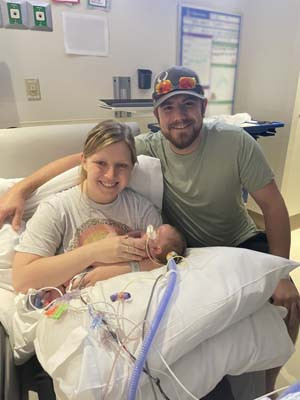
Postoperatively, Evelyn experienced several expected complications, including a respiratory viral infection, hepatic vein stenosis requiring stenting, transient vocal cord paralysis and arrhythmias. None resulted in long-term sequelae.
Gradually, she demonstrated improved perfusion, weight gain and energy. By the holiday season, she transitioned from intensive care to a medical-surgical unit and was later discharged to the Ronald McDonald House to facilitate close outpatient monitoring.
Life After Transplant
Evelyn returned home in early 2024 and continues to receive multidisciplinary follow-up through the Advanced Cardiac Therapies and Transplantation program. Her current regimen includes dual immunosuppression and arrhythmia management, along with scheduled labs, quarterly clinic visits and annual cardiac catheterizations.
“She’s doing extremely well clinically and developmentally,” said Kay-Leigh Lawrence, MSN, RN, CPN, CCTC, Nurse Coordinator. “Her progress has been excellent.”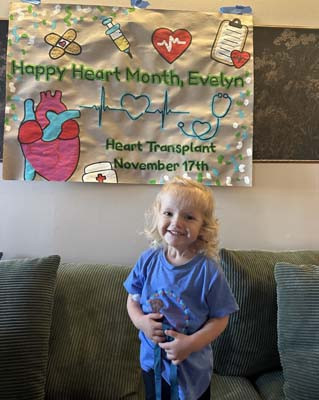
Now nearly 3 years post-transplant, Evelyn is meeting milestones with the support of speech, physical and occupational therapy. She is preparing to start preschool and recently took on a new role as an older sibling.
For her family and care team, Evelyn’s case highlights the importance of prenatal diagnosis, early multidisciplinary collaboration and individualized decision-making in managing complex congenital heart disease—even in the youngest patients.